Maintenance should respond to stocking, feeding, plants, filtration and test results. A fixed percentage or calendar is only a starting point. Keep a log so you can see whether water quality is stable and whether equipment performance is changing.
Daily checks
- Observe every fish: breathing, swimming, appetite, colour, body condition, injuries and unusual hiding or aggression.
- Check temperature and confirm the heater, filter and aeration are operating. Look for reduced flow, unusual noise, leaks or blocked intakes.
- Remove dead livestock, uneaten food and decaying plant material promptly using clean dedicated equipment.
- Check that lids, cables and electrical equipment are safe and that no household spray, soap or chemical has entered the area.
Weekly checks
- Test ammonia and nitrite, especially in new, recently stocked or unstable aquariums. Test nitrate and other parameters on a schedule appropriate to the tank and species.
- Perform a partial water change based on stocking, nitrate trend, waste accumulation and species requirements. Many freshwater tanks use weekly changes, but the amount must be adapted to results and sensitivity.
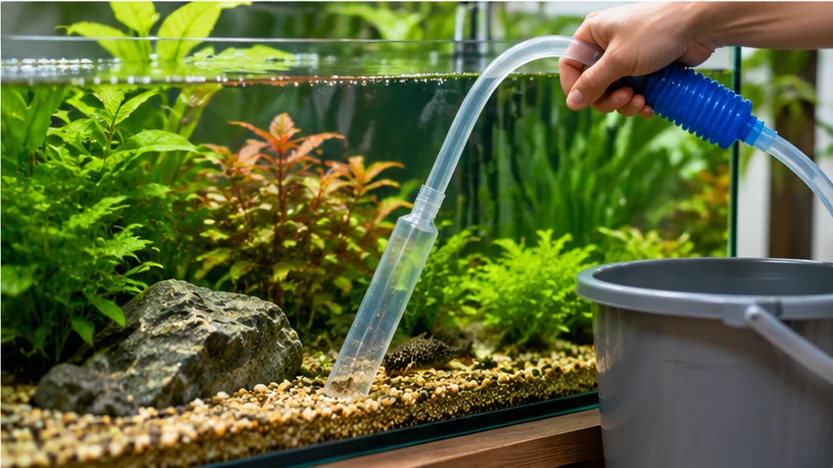
- Use a siphon to remove accessible debris from the substrate without stripping all biological surfaces bare.
- Clean viewing panels with aquarium-safe tools and inspect plants, décor and equipment.
Filter care
- Keep the filter running continuously. Biological filtration depends on oxygenated flow.
- When flow drops, inspect the intake, impeller, hoses and media for blockage.
- Gently rinse reusable sponge or biological media in removed aquarium water to remove sludge. Do not wash biological media under untreated tap water.
- Do not replace all media at once. If replacement is necessary, stagger it and preserve established media wherever possible.
- Chemical media such as activated carbon has a different role from biological media; replace or use it according to the product purpose rather than assuming it is essential in every filter.
Water-change method
- Prepare replacement water in a clean, dedicated container. Treat it for chlorine/chloramine as required and match temperature closely.
- Use a siphon or pump; never start a siphon by mouth.
- Add replacement water slowly to avoid disturbing fish, substrate or delicate plants.
- Do not make abrupt large chemistry changes in a tank with very different source water without understanding the risk. Old or neglected aquariums may need a staged recovery plan.
Monthly and periodic review
- Check heater, filter impeller, air pump, tubing, light timer and seals. Replace worn parts before failure.
- Trim plants, remove dead leaves and check that roots and décor do not obstruct flow.
- Review the maintenance log for trends in nitrate, pH, KH, filter flow and fish condition.
- Reassess stocking as fish grow. Adult size and waste load may make an initially workable setup unsuitable.
Important: Aquarium conditions and species requirements vary. Use species-specific advice and test results; these guides are educational and are not a veterinary diagnosis or a guarantee of compatibility.
Sources and further reading
← Back to the Aquarium Care Library · Open the Problem Solver A–Z